
Amazon S3
Use GrowthLoop audiences for file exports to Amazon S3.
Connect this destination to export audience membership as a CSV, for use in your own bucket and downstream tools.
This destination writes to your Amazon S3 bucket and is a good fit when you want to:
- Use a file export rather than a paid-media or messaging API
- Match contacts on a unique identifier
This maps to GrowthLoop Audiences:
| Use it for | Audiences |
|---|---|
| Dropping audience CSVs in an Amazon S3 bucket | ✓ |
If Adobe provisioned the bucket for Audience Manager onboarding, use Adobe Audience Manager instead.
Prerequisites
Make sure you have:
- An S3 bucket for GrowthLoop audience exports.
- An IAM user with a programmatic access key and a policy that grants write access to that bucket. Attach a policy like this, and replace the bucket ARN with yours:
{
    "Version": "2012-10-17",
    "Statement": [
        {
            "Sid": "VisualEditor0",
            "Effect": "Allow",
            "Action": [
                "s3:GetObjectVersionTagging",
                "s3:GetObjectAcl",
                "s3:GetObjectVersionAcl",
                "s3:DeleteObject",
                "s3:GetObjectAttributes",
                "s3:PutObject",
                "s3:GetObject",
                "s3:PutEncryptionConfiguration",
                "s3:GetEncryptionConfiguration",
                "s3:GetObjectTagging",
                "s3:GetObjectVersion",
                "s3:GetBucketACL"
            ],
            "Resource": [
                "arn:aws:s3:::test-export-from-fw",
                "arn:aws:s3:::test-export-from-fw/*"
            ]
        }
    ]
}
Set up Amazon S3 as a destination
- In GrowthLoop, click the Destinations tab on the left sidebar.
- Click New Destination in the top right corner.
- Search for S3 and click Add S3.
- Enter the required information, then click Create.
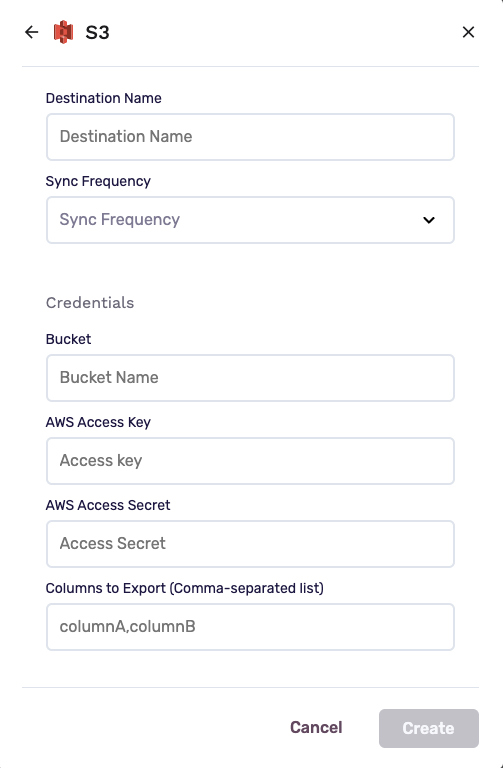
| Field | Description |
|---|---|
| Destination Name | Name this destination in GrowthLoop. Use a name so your team recognizes its purpose, like "Amazon S3 Exports". |
| Sync Frequency | Set the default export frequency (for example, daily or weekly). You can override this setting for individual exports. |
| Bucket | The bucket name as it appears in the AWS S3 console. |
| AWS Access Key | Access key for the IAM user. |
| AWS Access Secret | Secret access key for that user. |
| AWS Region | The AWS region for the bucket. |
| KMS Key (optional) | KMS key ID if the bucket uses customer-managed encryption. |
| Columns to Export (optional) | Comma-separated column list that limits the CSV to those fields, for example NAME,ADDRESS,CITY,STATE. |
| Prefix for Personalization Fields (optional) | Prefix GrowthLoop adds to personalization field names. Leave blank for no prefix. If you set one, it must start with a letter and use up to 5 letters or numbers. The default value is fw. |
GrowthLoop validates the connection. S3 then appears in your list of connected destinations.
Export to Amazon S3
From within GrowthLoop, export from an audience. See Export an audience if you need more information on these steps.
After building or selecting an audience, click Export, then search for your S3 destination.
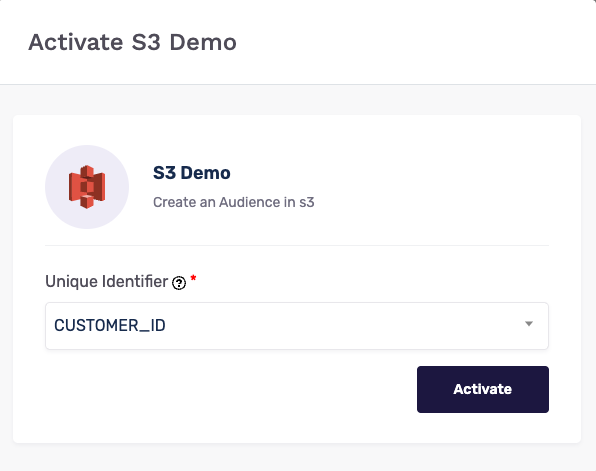
Map identifiers
Map Unique Identifier to the warehouse column that identifies each contact. You can also map custom attributes from the audience as additional fields.
Configure the export
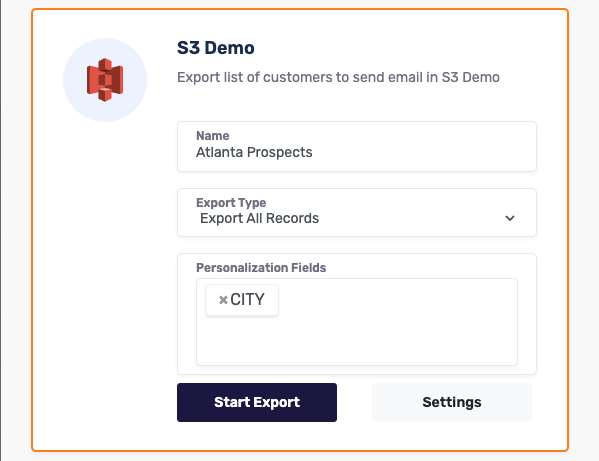
- Name: GrowthLoop uses this in the S3 filename.
- Export Type: Choose Export All Records for a full file on every run, or Export Updates (Deltas) to send a full file first and only changes after that.
- Personalization Fields: Optional. Select the columns you want in the CSV.
Export behavior
This is what GrowthLoop writes when you export an audience.
| Behavior | What happens |
|---|---|
| What GrowthLoop writes | A CSV in the S3 bucket you configured. Direction is GrowthLoop → Amazon S3. |
| When it runs | GrowthLoop sends the export as a batch on the next successful run. An export that starts Now runs within about 15 minutes. |
| File format | GrowthLoop writes a CSV to the bucket you configured. |
| Filename | The export name is included in the object name. |
| Export All Records | Each run writes the full audience. |
| Export Updates (Deltas) | The first run writes the full audience. Later runs write only changes. |
| Columns to Export | If you set this on the destination, GrowthLoop limits the CSV to those columns. |
Confirm the export was successful
When the run finishes, confirm you can use the data in Amazon S3.
- Audience export: Open the S3 bucket and look up the latest CSV.
In GrowthLoop, review counts on the audience Exports tab. See Export an audience for more information.
Congrats on successfully exporting to Amazon S3!
Troubleshooting
These are the issues we see most often. You can always email us at [email protected] for help.
| Problem | Cause | Resolution |
|---|---|---|
| Connection fails to validate | The IAM user cannot write to the bucket | Confirm the IAM user can PutObject on the bucket and prefix you configured |
| Files land in the wrong place | Bucket or AWS Region does not match the AWS console | Confirm Bucket and AWS Region match the bucket in the AWS console |
| Expected columns are missing | Columns to Export or Personalization Fields omit those columns | Check Columns to Export on the destination and Personalization Fields on the export |
Updated 27 days ago