
Microsoft Dynamics
Use GrowthLoop audiences and warehouse CRM data for Dynamics campaigns and records.
Connect this destination to export audience membership as Dynamics campaigns, opportunities, or activities, or to write warehouse rows onto Dynamics records, for use in Dynamics.
This destination writes to your Microsoft Dynamics account and is a good fit when you want to:
- Run sales outreach from GrowthLoop audiences
- Create or update Dynamics objects from a warehouse table
This maps to GrowthLoop Audiences and Syncs:
| Use it for | Audiences | Syncs |
|---|---|---|
| Creating campaigns, opportunities, or activities from an audience | ✓ | |
| Creating or updating Dynamics records from a warehouse table | ✓ |
Audience exports follow a CRM look-up journey. See CRM activation for match groups and actions. Syncs write object records. They do not run that look-up journey.
Prerequisites
Make sure you have:
- A Microsoft Dynamics 365 instance you can authorize for GrowthLoop.
- Permission to connect an app to that instance.
- Your Instance URL, such as
https://[organization].crm.dynamics.com/. The URL must includecrm.dynamics.com.
Set up Microsoft Dynamics as a destination
- In GrowthLoop, click the Destinations tab on the left sidebar.
- Click New Destination in the top right corner.
- Search for Microsoft Dynamics and click Add Microsoft Dynamics.
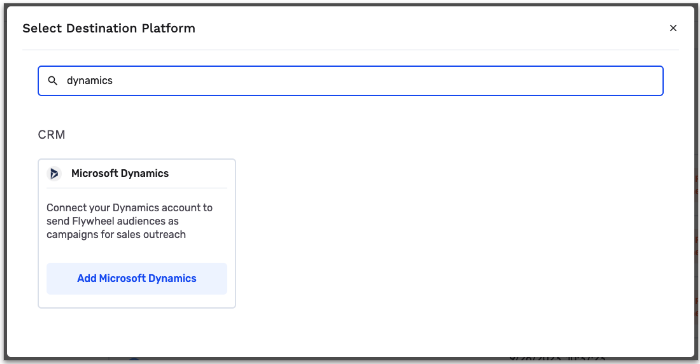
- Enter the required information, then click Create.
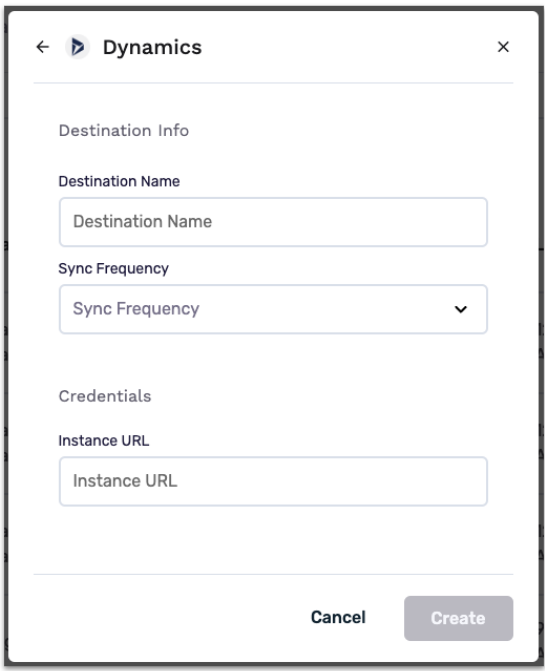
| Field | Description |
|---|---|
| Destination Name | Name this destination in GrowthLoop. Use a name so your team recognizes its purpose, like "Microsoft Dynamics CRM". |
| Sync Frequency | Set the default export frequency (for example, daily or weekly). You can override this setting for individual exports and syncs. |
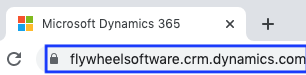
| Instance URL | Your Dynamics URL, such as https://[organization].crm.dynamics.com/. Do not omit crm.dynamics.com. |
Copy the Instance URL from your browser while you are signed in to Dynamics.
- Sign in to Dynamics and grant GrowthLoop access.
GrowthLoop validates the connection. Microsoft Dynamics then appears in your list of connected destinations.
Export to Microsoft Dynamics
From within GrowthLoop, export from an audience. See Export an audience if you need more information on these steps.
After building or selecting an audience, click Export, then search for Microsoft Dynamics.
The first time you export to this destination, click Activate. Set how GrowthLoop matches contacts and what it should create when it finds a contact, account, lead, or no match. Later exports reuse those destination settings.
See CRM activation for the look-up journey, match groups, and actions.
Map contact identifiers
In Activate, map the contact or account lookup field and the lead lookup field. The default lookup is email (emailaddress1). You can map another Dynamics field instead.
When GrowthLoop creates a contact or lead, include last name. You can also send first name, phone, and company name.
Configure the export
- Export Name: Defaults to the audience name.
- Campaign type: Choose a one-time or ongoing export.
- Schedule: Set frequency, start date, end date, and days of the week for ongoing exports.
- Campaign, opportunity, and activity fields: Enter the names and details your activation settings require, such as a new campaign name, an existing campaign, an opportunity name, or an activity due date.
Export behavior
This is what GrowthLoop writes when you export an audience.
| Behavior | What happens |
|---|---|
| What GrowthLoop writes | CRM actions from your activation settings: campaigns, opportunities, activities, or new contacts, accounts, or leads. Direction is GrowthLoop → Dynamics. |
| When it runs | GrowthLoop sends the export as a batch on the next successful run. An export that starts Now runs within about 15 minutes. |
| Match field | The contact/account and lead lookup fields you mapped in Activate. Default is email. |
| Creates | GrowthLoop creates the records and actions your activation settings allow. |
| One-time exports | GrowthLoop sends current membership once. |
| Ongoing adds and removals | Ongoing exports add contacts who enter the audience. Dynamics does not support removals. Contacts who leave the audience are not removed from Dynamics. |
| Deletes | GrowthLoop does not delete Dynamics records. |
Create a sync in GrowthLoop
Create a sync from a warehouse table to write rows onto Dynamics records. See Syncs for information on how to complete those steps.
Select an Object Type. GrowthLoop loads objects from your Dynamics instance, including standard objects such as Account, Contact, Lead, and Opportunity, and custom objects.
When you configure the sync:
- Connection: Select your Microsoft Dynamics destination.
- Object Type: Select the Dynamics object you want to write.
- Update Rule: Choose Insert, Update, or Upsert. See Sync behavior.
- Dataset/Table: Select the warehouse table that holds the records.
- Match Field: Map the lookup field GrowthLoop should use to find the record.
After you map fields, click Update Sync. Enable the sync with the toggle at the top of the page.
When you update mappings on an existing sync, choose Updates only unless you need Back-fill. Back-fill rewrites already synced rows and can be expensive on your warehouse.
Syncs write object records. They do not create campaigns or run the audience look-up journey. To create campaigns, opportunities, or activities from an audience, export the audience.
Sync behavior
| Behavior | What happens |
|---|---|
| When it runs | GrowthLoop sends the sync as a batch on the next successful run. |
| Insert | GrowthLoop creates records that do not already have a Dynamics object ID. Rows that already have an ID are skipped. |
| Update | GrowthLoop updates mapped fields on matching records. |
| Upsert | GrowthLoop looks up the record by the match field you mapped and inserts or updates. |
| Objects | GrowthLoop writes to the object you selected. That object must already exist in Dynamics. |
| Campaigns | Syncs do not add contacts to a campaign or create opportunities and activities. |
| Deletes | GrowthLoop does not delete Dynamics records. |
Confirm the export was successful
When the run finishes, confirm you can use the data in Microsoft Dynamics.
- Audience export: Look up the campaign, opportunity, activity, or new record your activation settings create.
- Contact sync: Search for the contact and check the mapped attributes.
- Lead sync: Search for the lead and check the mapped attributes.
- Account sync: Search for the account and check the mapped attributes.
In GrowthLoop, review counts on the audience Exports tab, or confirm the sync appears in the Syncs table. See Export an audience or Syncs for more information.
Congrats on successfully exporting to Microsoft Dynamics!
Troubleshooting
These are the issues we see most often. You can always email us at [email protected] for help.
| Problem | Cause | Resolution |
|---|---|---|
| Connection fails to validate | Instance URL is wrong, or you do not have access to that instance | Paste the URL from your browser. It must include crm.dynamics.com. Sign in with a user who can access that instance |
| You cannot export until you activate | The destination is not activated for this dataset | Click Activate and finish the match and action settings |
| A new contact or lead fails | Last name is missing | Map last name when GrowthLoop creates contacts or leads |
| Contacts who left the audience are still in Dynamics | Dynamics exports do not support removals | Update or close those records in Dynamics |
| A sync did not create a campaign | Syncs write object records only | Export an audience to create campaigns, opportunities, or activities |
| A sync insert skipped a row | Update Rule is Insert and the row already has a Dynamics object ID | Use Upsert to update existing records, or Insert only for new rows |
Updated 22 days ago