
Role management and permissions
Assign roles per team and understand how permissions combine in GrowthLoop.
GrowthLoop roles control what a user can do in the team they are currently using. A user can have different roles on different teams, and can have more than one role on the same team. Within the active team, permissions from that user's assigned roles combine. Roles assigned on other teams do not add permissions in the active team.
NoteThis guide describes team-specific roles when enabled for your organization. If you still see a single Role dropdown for each user, your organization uses organization-level roles. Contact [email protected] for help with availability.
How roles work
For example, you can assign Admin on your Marketing team and User on your Analytics team to the same teammate. When they switch teams, GrowthLoop uses the roles assigned to that team.
You can see role labels beside teams in the team switcher and in Organization > Users and Teams. In Users, use Search to find teammates by role name as well as by name or email.
Built-in permissions
GrowthLoop includes three built-in roles. Your organization can also configure custom roles. The table below describes the standard roles; your organization's configuration can differ. Assign one or more roles separately for each team:
| Action | User | Admin | Owner | Action Definition |
|---|---|---|---|---|
| Create Audiences | ✅ | ✅ | ✅ | Creates audience |
| Edit Audiences | ✅ | ✅ | ✅ | Edits audiences* |
| Delete Audiences | ✅ | ✅ | ✅ | Deletes audiences* |
| View Audiences | ✅ | ✅ | ✅ | Views audience* |
| List Audiences | ✅ | ✅ | ✅ | Views list of all audiences* |
| Create Templates | ✅ | ✅ | ✅ | Creates templates |
| Edit Templates | ✅ | ✅ | ✅ | Edits templates |
| Delete Templates | ✅ | ✅ | ✅ | Deletes templates |
| Create Exports | ✅ | ✅ | ✅ | Exports audiences* |
| Update Exports | ✅ | ✅ | ✅ | Updates Exports* |
| CSV Exports | ❌ | ✅ | ✅ | Exports audiences to CSV (limited to < 300k records) |
| Create Destination | ✅ | ✅ | ✅ | Creates Destinations |
| Delete Destination | ✅ | ✅ | ✅ | Deletes Destinations |
| Create Studio | ✅ | ✅ | ✅ | Creates audiences in studio |
| Create Journey | ✅ | ✅ | ✅ | Creates journeys |
| Update Journeys | ✅ | ✅ | ✅ | Updates journeys |
| Delete Journeys | ✅ | ✅ | ✅ | Deletes journeys |
| Create Syncs | ✅ | ✅ | ✅ | Creates syncs |
| Update Syncs | ✅ | ✅ | ✅ | Updates syncs |
| View Activity | ❌ | ✅ | ✅ | Views activity across audiences and syncs in central dashboard |
| Create Datasets | ❌ | ✅ | ✅ | Creates Datasets |
| List Datasets | ❌ | ✅ | ✅ | Views a list of all Datasets |
| View Dataset | ❌ | ✅ | ✅ | Views details of a specific dataset |
| Update Dataset | ❌ | ✅ | ✅ | Updates Datasets |
| Create Dataset Groups | ❌ | ✅ | ✅ | Creates Dataset Groups |
| List Dataset Groups | ❌ | ✅ | ✅ | Views a list of all Dataset Groups |
| View Dataset Group | ❌ | ✅ | ✅ | Views a specific Dataset Group |
| Update Dataset Groups | ❌ | ✅ | ✅ | Updates Dataset Groups |
| PII Management | ❌ | ✅ | ✅ | Uses fields labeled as PII in exports for personalization of marketing messages |
| List Teams | ✅ | ✅ | ✅ | Views a list of all teams in organization |
| Edit Teams | ❌ | ✅ | ✅ | Adds or removes users from teams |
| Manage team roles | ❌ | ✅ | ✅ | Changes another user’s roles, subject to the restrictions below |
| List Users | ✅ | ✅ | ✅ | Views a list of all users in organization |
| Review Audiences | ❌ | ✅ | ✅ | Reviews and approves audiences for export |
| Refresh Source Connection | ❌ | ✅ | ✅ | Refreshes Source Connection |
| Create Sources | ❌ | ✅ | ✅ | Adds source ingests to Data Cloud |
| List Sources | ❌ | ✅ | ✅ | Views list of all source ingests |
| Create Invites | ❌ | ❌ | ✅ | Invites users to join organization |
| List Invites | ❌ | ❌ | ✅ | Sees list of all invites to organization |
| Create Storage | ❌ | ❌ | ✅ | Sets external storage configuration for exports |
| Update Notifications | ❌ | ❌ | ✅ | Sets who in the organization receives notifications |
| Update Share Settings | ❌ | ❌ | ✅ | Sets default audience share settings for organization |
| Create Source Connection | ❌ | ❌ | ✅ | Creates source connection for organization |
| List Source Connections | ❌ | ❌ | ✅ | Views list of all source connections |
| Update Source Connections | ❌ | ❌ | ✅ | Assigns Source Connections to specific teams and modifies logging settings |
| User activity audit logs | ❌ | ✅ | ✅ | Visibility of actions taken by any user |
*Audiences that are shared with them as editor
Custom roles
NoteCustom roles are available on GrowthLoop Enterprise plan
GrowthLoop roles can be customized for your enterprise teams. You can define custom roles for your organization with granular permissions on datasets, audiences, and other objects. The role definitions are available in your organization, but permissions apply to a user only on teams where you assign that role.
To request a custom role, choose the permissions you need and give the role a name. Contact your GrowthLoop representative to configure it.
Our team will configure the custom roles for your organization in GrowthLoop. You can assign one or more of those roles to a user's assignment on each team.
Assign roles to a teammate
You need role-management permission in your active team to change another user's roles. The standard Admin and Owner roles include this permission. Switch to a team where you have the appropriate permission before managing roles.
To change a teammate's roles:
-
Open the profile dropdown in the header and select Organization, then select the Users tab.
-
Select the user's row to open the user modal.
-
Under Teams and roles, choose one or more roles for each team the user belongs to.
-
Click Save. The changes apply to the selected teams only, and the organization views update without a page refresh. Reopen the user to verify the saved roles.
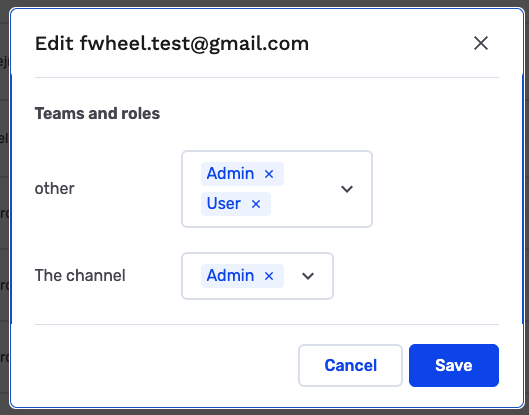
Use the permissions table above to compare the permissions associated with each built-in role. When a user has multiple roles on their active team, GrowthLoop combines the permissions from those roles. Permissions from roles assigned to other teams do not apply to the active team.
Role-management restrictions
-
Select at least one role for each team membership. To remove someone from a team, change their team membership.
-
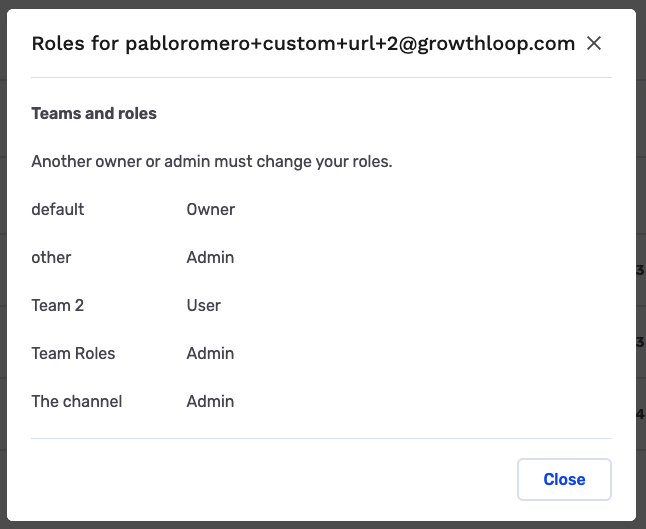
Ask another authorized user to change your roles. Your own role editor is read-only.
-
With the standard Owner role in your active team, you can grant or remove roles, including Owner, for another user in your organization.
-
With the standard Admin role, you can manage other users' roles, but you cannot make someone an Owner for the first time in the organization or remove their last Owner role there. You can assign Owner on another team to someone who is already an Owner, or remove it from one team while they remain an Owner on another.
SSO and API access
If you use single sign-on (SSO), you can map identity-provider groups to teams and roles. Multiple matching groups can contribute roles to the same team. See SSO team and role mappings.
For integrations, use the effective team role arrays returned by the Users API and Me API. The legacy organization_role field remains for compatibility and does not describe a user's roles on every team.
Ready to manage team membership? Continue to Manage organizations and teams. For help with roles, contact [email protected].
Updated 10 days ago